
The fastest, most durable lead mix for most contractors is a Google Business Profile that's fully claimed and optimized, a referral system that runs on autopilot, and one paid channel (a marketplace or Google Local Services Ads) for volume while the organic side builds. That combination works because it splits the job three ways: referrals and Google Business Profile cost nothing but time and compound over months, while the paid channel buys you speed you can't get any other way in week one.
Here's the 72-hour move: claim and completely fill out your Google Business Profile, add real job photos, and set a rule that every inquiry gets a response within one hour. That single habit, done consistently, drives free inbound calls that no paid platform can match on cost. Everything else in construction lead generation builds on top of that foundation.
Key Takeaways
Construction lead generation works best when owned channels, referrals, and one fast paid channel run together, backed by tracking that measures booked jobs, not just inquiries.
| Point | Details |
|---|---|
| Claim your Google Business Profile | Complete every field and add project photos to capture free, high-intent local search traffic. |
| Systematize referrals | Ask every satisfied customer for a review and a referral before the job wraps up. |
| Run one paid channel test | Try Local Services Ads or a marketplace matched to your trade for 30 days with a set budget. |
| Track cost per booked job | Use unique phone numbers, UTM tags, and CRM source tagging, not cost-per-lead alone. |
| Fix quoting speed first | Respond within the hour and quote transparently before buying more leads. |
| Combine operations with acquisition | Mbqs's MB 360 Trade Growth System pairs SearchRankPro™ digital growth with commercial support to lift close rates, not just lead volume. |
Table of Contents
- Construction Lead Generation Tactics Ranked by Speed and Payback
- Which Lead Platforms Should Contractors Actually Try?
- How Do You Qualify a Lead Before You Chase It?
- What Does Construction Lead Generation Actually Cost?
- How Do You Track Leads and Prove ROI?
- How Should You Prioritize Channels for Your Business?
- MB's Proven Framework for Turning Leads Into Booked Jobs
- A Construction Marketer's Blunt Take on What Actually Works
- Get Help Turning Leads Into Booked Revenue
- Sources
Construction Lead Generation Tactics Ranked by Speed and Payback
Not all lead sources pay off on the same timeline, and confusing a slow-build channel with a fast one is how contractors waste a marketing budget in month one. Some tactics book a job by Friday. Others take a quarter to show results but cost you nothing per lead once they're running. Here's how the major categories stack up, ranked roughly by how fast they typically start producing bookable work.
- Referral systems — Ask every satisfied customer for a review and a name of someone else who needs work. Fastest close rate of any channel because trust is already built in. Downside: volume is capped by your current job count.
- Google Business Profile (owned, free) — Complete profile with photos, services, and service-area settings. Drives inbound calls from people already searching for your trade nearby. Takes a few weeks to gain traction, then compounds.
- Google Local Services Ads (LSA) — Pay-per-lead, Google-verified badge, appears above organic results. Fast setup, quick lead flow once your budget and screening questions are dialed in.
- Paid marketplaces (Angi, Thumbtack, Houzz) — Immediate lead volume the day you sign up. Lead quality and exclusivity vary widely by platform and market.
- PPC / Google Search Ads — Fast to launch, full control over keywords and landing pages, but requires ongoing budget and conversion tracking to stay profitable.
- Local SEO (organic) — Slower to build, usually 3 to 6 months before it produces consistent volume, but leads arrive at near-zero marginal cost once rankings hold.
- Facebook / Instagram ads — Strong for residential remodel, roofing, and specialty trades with visual before-and-afters. Slower qualification than search-intent channels since viewers aren't always actively shopping.
- BuildingConnected and bid-based platforms — Built for commercial subcontractors chasing bid invitations and project discovery rather than homeowner calls.
- The Blue Book and Dodge/Construction.com — Directory and project-lead databases aimed at commercial general contractors and subs tracking bid opportunities.
- Yard signs and vehicle wraps — Low cost, slow burn, strongest in dense residential neighborhoods where you're already doing visible work.
- Content and video (project walkthroughs, YouTube) — Builds trust and search visibility over months; pairs well with local SEO and social ads.
- Trade partnerships (realtors, inspectors, suppliers) — Reliable trickle of pre-qualified leads once relationships are established, but takes deliberate networking to set up.
The trick isn't picking one. It's matching two or three to your crew size and job value, then instrumenting them well instead of spreading a thin budget across everything at once, which is the mistake most contractor lead generation guides flag first.
Which Lead Platforms Should Contractors Actually Try?
Every major marketplace pitches volume, but they're built for different trades, job sizes, and levels of patience. Knowing what each platform actually optimizes for saves you from signing a contract that doesn't fit your business.
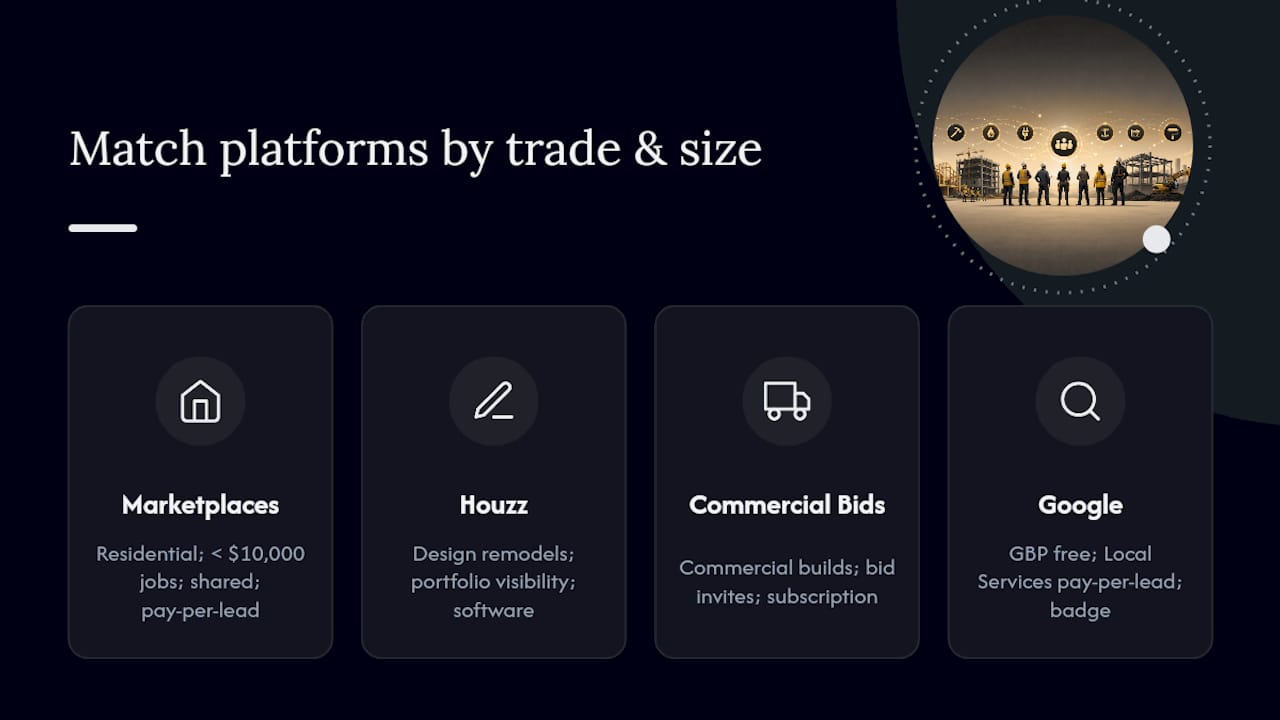
Angi and HomeAdvisor run mostly on a pay-per-lead model, charging you for each homeowner inquiry whether or not it converts. They work best for residential trades with jobs under $10,000 where volume matters more than exclusivity. Expect leads shared with two or three other contractors, so speed of response decides who wins the job.
Houzz leans toward design-forward remodeling and renovation work, pairing a lead marketplace with project-management software. Reviews on platforms like Capterra note that its combined software and lead tools appeal most to design-build firms and kitchen and bath remodelers who want portfolio visibility alongside inquiries.
Thumbtack uses a pay-per-lead or bid-credit system where contractors pay to respond to specific job requests. It suits smaller trades and handyman-style work where fast, low-cost jobs are the norm.
BuildingConnected is a different animal entirely. It's built for commercial subcontractors chasing bid invitations on larger projects, not homeowner leads. If your business bids on commercial builds, this is where general contractors and owners post project opportunities.
The Blue Book and Dodge/Construction.com both function as project databases and directories for commercial work, connecting subs and suppliers to active bids. They're subscription-based and suited to firms with the staff to track and respond to multiple bid opportunities at once.
Google Business Profile costs nothing beyond your time, and it's the single highest-leverage owned asset a local contractor has. Google Local Services Ads run pay-per-lead with a Google-verified badge, landing above standard search ads. Facebook and Instagram ads run on pay-per-click or pay-per-impression, working best for visually compelling residential work like roofing, landscaping, or kitchen remodels.
For test priority, match the platform to your job value. A painter doing $2,000 jobs should test Thumbtack or Angi first. A commercial electrical sub bidding $200,000 jobs should skip the homeowner marketplaces entirely and go straight to BuildingConnected or Dodge. A roofer somewhere in between often does best starting with Local Services Ads, since Google's verification badge and pay-per-lead structure tend to produce higher-intent calls than open marketplaces.
How Do You Qualify a Lead Before You Chase It?
A lead isn't a job. Treating every inquiry as equally worth your time is how crews burn hours on estimates that never close. Run every incoming lead through a short filter before you commit an estimator's afternoon to it.
Ask these five questions on the first call:
- What's the timeline for starting the project?
- Is there a set budget range, and have they gotten other quotes?
- Do they own the property, or are they a tenant or agent inquiring on someone's behalf?
- Is this an emergency repair or a planned renovation?
- Have they already selected materials, or do they need design guidance too?
Red flags that predict a lead won't close:
- Vague answers about budget paired with requests for the lowest possible price
- Refusal to schedule an in-person or video walkthrough
- Multiple past contractors mentioned with complaints about all of them
- No urgency and no firm timeline, just "shopping around"
Vetting a paid lead provider deserves the same rigor. Before signing anything, ask the sales rep directly: What's the exact billing model, per lead or per month? What's the refund policy on bad leads, like wrong phone numbers or out-of-area requests? Is the lead exclusive to you, or shared with competitors? Who owns the homeowner's contact data once you've paid for it? Can you see a sample lead before committing? What are the cancellation terms if the leads underperform in the first 30 days?
A simple scoring rubric keeps follow-up prioritized when leads pile up:
- 3 points: Homeowner, firm timeline under 30 days, budget stated
- 2 points: Firm timeline but vague budget, or budget stated but timeline undefined
- 1 point: Early-stage research, no timeline, price-shopping tone
- 0 points: Missing contact info, out of service area, or clearly a duplicate submission
Pro Tip: Call back within five minutes of a lead coming in, not five hours. Contractors who quote first often win the job regardless of price, because most homeowners stop shopping once they've had one good conversation.
What Does Construction Lead Generation Actually Cost?
Cost-per-lead varies enormously by trade, market, and channel, so treat any flat number you see online with suspicion. What matters more than the average is understanding the shape of the cost across channels so you can budget realistically.
Paid marketplaces tend to charge per inquiry, and that charge climbs with job value and trade specialization. Electrical and HVAC leads typically cost more than general handyman leads because the average ticket is higher and competition for verified inquiries is fiercer. Google Local Services Ads and PPC both run on auction pricing, so cost per lead shifts with local competition and seasonality. Storm season, for instance, spikes roofing PPC costs almost overnight in affected regions. Referrals, by contrast, cost you nothing directly, though many contractors offer a modest referral incentive to keep the pipeline active.
Budget rules of thumb that hold up across trades:
- Allocate 3% to 7% of gross revenue to marketing if you're an established contractor with steady referral flow.
- Allocate 8% to 12% if you're newer or actively trying to grow beyond your current capacity.
- Set aside a fixed test budget, not your whole marketing spend, before trying a new paid channel.
- Never judge a channel's ROI before it's had a full sales cycle to convert, which for larger jobs can run four to eight weeks.
A 30-day test plan to validate two channels at once:
- Week 1: Fully optimize your Google Business Profile and launch a Local Services Ads campaign with a modest daily cap.
- Week 1: Simultaneously sign up for one marketplace platform matched to your trade and job size.
- Week 2 to 3: Respond to every lead within the hour, log source and outcome for each in a spreadsheet or CRM.
- Week 4: Compare cost per lead, cost per booked job, and close rate between the two channels.
- Day 30: Cut or scale each channel based on which produced profitable bookings, not just cheap inquiries.
How Do You Track Leads and Prove ROI?
Cost-per-lead alone tells you almost nothing useful. The metric that actually matters is cost per booked job, and you can't calculate that without tracking every lead from first contact through final invoice.
The essential KPIs to watch:
- Total leads — raw inquiry count by source, tracked weekly.
- Qualified leads — leads that pass your phone-screen filter above.
- Contact-to-quote time — how fast you get an estimate in front of the prospect.
- Quote-to-book rate — the percentage of estimates that convert to signed jobs.
- Cost per booked job — total spend on a channel divided by jobs actually won from it.
- Customer lifetime value — repeat and referral revenue generated from a single original lead over time.
Setting this up doesn't require enterprise software.
- Use a unique tracking phone number for each major channel (marketplace, LSA, website).
- Build a simple dedicated landing page for paid campaigns instead of sending traffic to your homepage.
- Tag every ad and social post with UTM parameters so web traffic sources are visible in analytics.
- Log every lead's source directly into your CRM the moment it arrives, not at end of week.
| KPI | Definition | How to capture it |
|---|---|---|
| Total leads | Raw inbound inquiries by source | Unique phone numbers and tagged web forms per channel |
| Qualified leads | Leads passing budget, timeline, and ownership screen | Manual tagging in CRM after first call |
| Contact-to-quote time | Days between first contact and delivered estimate | Timestamp fields in CRM or spreadsheet |
| Quote-to-book rate | Percentage of quotes that convert to signed jobs | Won/lost status tracked per estimate |
| Cost per booked job | Channel spend divided by jobs won from that channel | Spend data from platform, jobs won from CRM |
General guidance from contractor marketing resources consistently points to the same lesson: tag every lead by source in one central system, because splitting tracking across a spreadsheet, a marketplace dashboard, and memory is how contractors lose sight of which channel is actually paying for itself.
How Should You Prioritize Channels for Your Business?
Not every contractor should be running the same playbook. A residential painter and a commercial mechanical sub have almost nothing in common when it comes to where their next job comes from, so run your channel choices through a quick filter first.
Ask yourself: What's your average job value? What's your team's actual capacity to respond to inquiries within the hour? Is your work seasonal, and if so, which months need the heaviest lead flow? How wide is your service area, and are you competing with a dozen other contractors or three?
For residential, small-ticket work (under $10,000 average job), prioritize paid marketplaces, Local Services Ads, and referrals first. Volume matters more than exclusivity, and fast response wins the job more often than the lowest bid.

For commercial or high-ticket work (large renovations, mechanical, electrical, structural), prioritize BuildingConnected, Dodge, The Blue Book, and direct relationships with general contractors and developers. Marketplace platforms built for homeowners rarely surface the right buyers here.
| Channel tier | Entry-level (test first) | Scale (once profitable) | High-ticket (commercial/specialty) |
|---|---|---|---|
| Residential small-ticket | Marketplace + LSA | Local SEO + referral system | Social ads for visual trades |
| Mid-ticket remodel | LSA + Houzz-style platform | PPC + content/video | Trade partnerships |
| Commercial/subcontractor | Direct GC relationships | The Blue Book, Dodge | BuildingConnected bid access |
A framer doing $3,000 residential jobs and a mechanical contractor bidding $500,000 commercial builds should never be reading the same channel-priority list as if it applies equally to both.
MB's Proven Framework for Turning Leads Into Booked Jobs
Generating leads and converting them are two different problems, and most contractors only ever solve the first one. Mbqs built the MB 360 Trade Growth System and SearchRankPro™ specifically to close that gap by pairing commercial operations work with targeted digital growth.
The core insight behind the framework is simple: a contractor who quotes faster and prices with confidence closes more of the leads they already have, before spending another dollar on new ones. Fixing the operational side of a business often does more for booked revenue than doubling ad spend.
The framework runs in five stages:
- Diagnose — Review current lead sources, response times, and close rates to find where leads are leaking out of the pipeline.
- Local SEO and Google Business Profile — Optimize the owned channels that produce the highest-quality, lowest-cost leads over time.
- Paid test campaigns — Run controlled Local Services Ads or PPC tests matched to trade and job value, avoiding wasted spend on the wrong platform.
- Conversion operations — Tighten quoting speed and pricing clarity, informed by Mbqs's quantity surveying and cost planning background, so estimates go out faster and with fewer revisions.
- Tracking — Set up the KPI and CRM tagging structure described above so every dollar spent on lead generation is measured against jobs actually booked.
The reasoning holds up against the data throughout this guide: precise targeting and fast follow-up consistently outperform broad, untargeted spend, and contractors who quote first tend to win the job regardless of price. Combining better-targeted acquisition with faster, tighter quoting is how Mbqs's clients report improved margins alongside stronger lead flow, not from one lever alone but from both working together.
Pro Tip: If your close rate is under 30% on qualified leads, don't buy more leads yet. Fix your quoting speed and pricing clarity first. More traffic into a leaky funnel just means more wasted estimates.
A Construction Marketer's Blunt Take on What Actually Works
Most contractors buy leads the way they'd buy lumber: more volume, lower price, hope it works out. That's backward. A lead is only worth what your team can do with it in the first hour, and most crews are still slower to respond than they think.
Answer fast, every time. A five-minute callback beats a same-day callback, which beats a next-day callback by a wide margin. Homeowners calling three contractors usually book the first one who shows up prepared, not the cheapest one.
Price transparently on the first call. Give a real range before the in-person estimate if you can. Vague pricing wastes everyone's time and trains prospects to keep shopping past you.
Pre-qualify by phone before scheduling a walkthrough. Five minutes of questions saves an hour of driving to a job that was never going to book.
Protect your margins when buying leads. A cheap lead that doesn't close is more expensive than an exclusive lead that does. Run the actual cost-per-booked-job math before judging a platform by its sticker price.

The most common mistake I see is contractors treating every paid channel like a slot machine, pulling the lever harder (more budget) instead of adjusting the machine (better targeting, faster response, tighter qualification). The second most common mistake is running ads with no landing page and no tracking number, so three months later nobody can say which channel actually produced the jobs on the books.
One last note: whatever CRM or estimating tool you use, make sure lead intake flows directly into it. A lead sitting in a text thread or a sticky note is a lead that gets forgotten.
Get Help Turning Leads Into Booked Revenue
Building a lead pipeline from scratch while running job sites is a lot to carry alone, and most contractors don't have a spare afternoon to test five platforms and build a tracking spreadsheet. Mbqs built SearchRankPro™ and the MB 360 Trade Growth System specifically so contractors get both sides handled at once: the digital growth work that brings leads in, and the commercial operations support that helps you close them faster.
These packages suit trades ready to move past word-of-mouth alone, whether you're a small crew looking for a low-friction entry point or a growing commercial subcontractor targeting bigger job values. Smaller or newer businesses often start with the STARTup Visibility Pack for a lighter-weight entry into local SEO and Google Business Profile optimization before scaling into the full system.
If you're ready to see where your current lead pipeline is leaking revenue, reach out through the SearchRankPro™ page to review your options, or start at Mbqs if you're not sure which package fits your trade yet.
Sources
The sources and tools below back the recommendations throughout this guide and give you a starting point for deeper research on specific platforms or tracking setups.
- Contractor Lead Generation: 12 Ways to Get More Leads
- How to Get More Construction Leads: 21 Proven Methods (2026)
- Electrician Lead Generation for Residential and Commercial Jobs | Dolead
How Long Does Construction Lead Generation Take to Show Results?
Paid channels like Local Services Ads and marketplaces can produce leads within days of launch. Organic channels like local SEO typically need three to six months of consistent optimization before producing steady, low-cost volume, based on patterns seen across contractor marketing case studies. Referrals can produce a lead immediately if you ask at the right moment, but building a reliable referral pipeline usually takes a few completed jobs to gain momentum.
What's a Reasonable Budget for a Contractor Just Starting Out?
Should I Use a Paid Marketplace or Build My Own Website and SEO?
Most contractors benefit from both, run in parallel rather than sequentially. A paid marketplace or Local Services Ads campaign gets leads flowing immediately while your Google Business Profile and local SEO build toward lower-cost, higher-margin leads over the following months.
How Do I Know if a Lead Provider Is Worth the Cost?
Ask directly about billing model, refund policy on bad leads, exclusivity, and who owns the contact data once you've paid. Request a sample lead before committing, and track your actual cost per booked job from that provider over at least 30 days before judging the relationship.
What's the Single Biggest Mistake Contractors Make With Lead Generation?
Treating cost-per-lead as the only metric that matters. A lead that costs more but closes at a much higher rate is nearly always the better investment, which is why tracking cost per booked job and quote-to-book rate matters more than a cheap up-front price.